There is currently a shift in digital marketing that analysts are calling “The Great Decoupling.” While global search volumes continue to climb, reaching an estimated 13.6 billion daily searches by 2025, the volume of clicks exiting the search results page to external websites is declining.
Experts predict that the search volume of traditional search engines will drop up to 25% this year as AI chatbots and virtual agents become the primary means by which users find answers. However, consumer attention is not disappearing. This shift means that the referral economy that powered the web for 20 years is being replaced by an extraction model where AI delivers the value directly on the results page.
As AI Overviews push traditional links further down the page, your brand must stop chasing simple rankings and start optimizing for model influence and true impact.
How User Attention Moves From Search Engines to Generative Engines
The decline in traditional search clicks is driven by a behavioral migration toward platforms that offer immediate, zero-friction gratification. Users are no longer asking for a list of documents. They are asking for a synthesized perspective that solves their problem instantly. In this blog post, we outline the core pillars of this shift:
| Generative Engine Optimization (GEO) | Structure your digital presence to become the primary cited source for AI platforms. |
| Answer-First Content Architecture | Lead with concise, 40–60 word summaries that AI models can easily extract and attribute. |
| Brand Search Volume as an SEO Signal | Build a consistent footprint on high-authority platforms like Wikipedia, Reddit, and other credible sources to boost AI visibility. |
| Agentic Workflows | Prioritize machine-readable structured data to ensure autonomous AI agents can process your site. |
Generative Engine Optimization (GEO): How to Become the Primary Cited Source for AI Answers
Generative Engine Optimization (GEO) is the practice of structuring your digital presence so that AI platforms can retrieve and recommend your brand when answering user questions. AI mentions are the new backlinks.
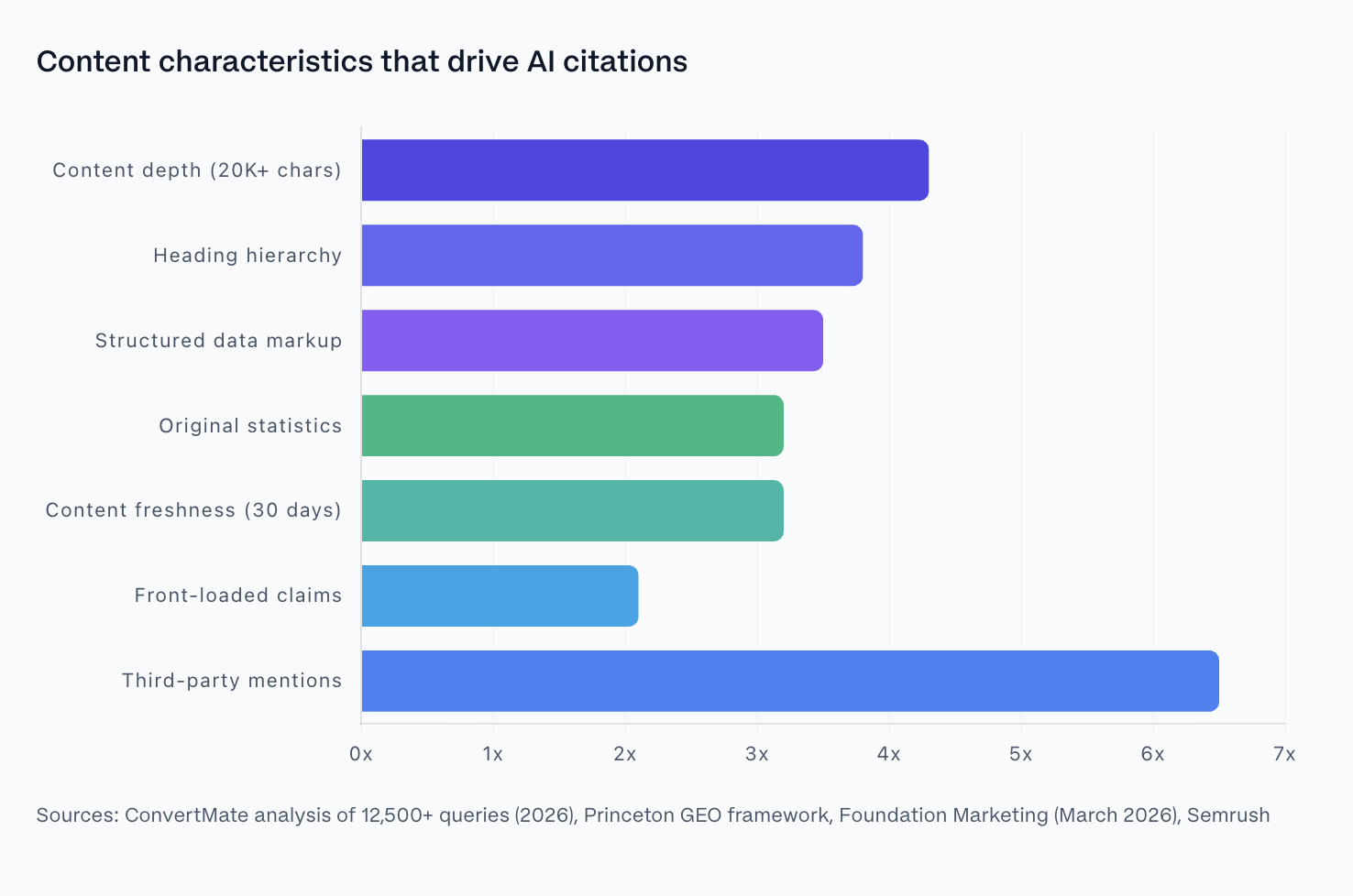
Brands cited by AI see conversion rates four to five times higher than traditional organic search because the visitor arrives pre-qualified by the recommendation of the AI. To succeed, your brand must increase its factual density by integrating original statistics and expert quotations that LLMs crave to ground their answers.
Implement Answer-First Architecture: Prevent AI From Skipping Your Content
Content architecture must pivot to an answer-first model to survive the search volume drop. AI engines pull answers in discrete chunks or fragments. If your core insight is buried in paragraph three, the model will likely skip your page.
Marketers should lead every section with a concise summary (40–60 words) that directly answers the primary question, followed by supporting depth that makes a click worth the time of the users.
Brand Search Volume as an SEO Signal: Leverage Third-Party Footprints
Branded search volume has emerged as the strongest predictor of AI chatbot mentions. Because AI models construct knowledge graphs based on consistent entity information across the web, traditional brand building—including PR, social media, and community engagement—is now a critical technical SEO activity.
Companies that maintain a consistent footprint across third-party platforms like Wikipedia and Reddit are 2.8 times more likely to be surfaced in AI responses.
Agentic Workflows: Ensure Your Brand Is Accessible by Autonomous AI
As AI matures from conversational dialogue to autonomous execution, we see the emergence of the Agentic Web. These specialized virtual agents prioritize machine-readable data over traditional human-centric design.
To maintain influence in this new AI ecosystem, you should lean toward technical optimization, implementing structured data into the website. By ensuring that pricing, availability, and specifications are interpretable by machines, you secure your position as the cited authority.
Source: https://www.convertmate.io/research/geo-benchmark-2026
Beyond the Click: Measuring Success Through AI Impression Share
Gartner predicts search engine volume will drop 25% by 2026. For our clients, this prediction is not a panic signal, but a moment to redirect toward influence acquisition. While the quantity of traffic is declining, the quality is surging: AI-sourced visitors convert four to five times better compared to traditional search.
Why is this happening? Because the AI has already done the “window shopping” for the users. Users will not browse a large number of websites anymore. They are arriving on your website ready to buy or sign up because the AI already answered their basic questions.
It is not enough to report on clicks anymore. You need to report on LLM Impression Share: how often your brand is the definitive source used by the machine to guide the choice of a customer.
Advance Insights: How do you get cited by AI
AI-driven search is fast and often confusing. We sat down with our Head of Online Marketing, Christoph Voellmy, to answer the questions most frequently asked by CMOs.
Question: Is traditional SEO officially dead?
Not dead, but transformed. High Google rankings still provide an authority foundation for AI citations. Around 76% of AI Overview citations currently come from pages in the top ten organic results. SEO now serves as the bedrock for AI visibility rather than the sole destination.
Question: How do we measure success if users aren’t clicking through to our site?
We change to Visibility-First metrics. The new KPIs are AI Citation Frequency, AI Answer Inclusion Rate (AAIR), and Branded Search Lift. If an AI answers the question of a prospect using your data, you have won the mental impression even without the session.
Question: What is the sustainable way to get cited by ChatGPT or Perplexity?
It is a new discipline, and there are a lot of moving parts and unknown elements. However, High factual density, heading hierarchy, structured data, and original research that gets cited by third parties is a good foundation to increase your Generative Engine visibility because LLMs preferentially cite sources that provide original and structured data.
Important Considerations
- Mention Volatility: AI citations are unstable; 40–60% of domains cited in AI answers can change within a single month.
- The no-referrer Problem: Some LLM paid accounts strip referral data, often misclassifying your best-converting traffic as “direct” in GA4.
- Freshness Bias: AI engines, especially Perplexity, heavily weight recency; content updated within the last 90 days is significantly more likely to be cited.
Your Next Steps for AI Dominance
The window for first-mover advantage in GEO is narrowing. With 62% of CMOs already adding AI search visibility as a KPI for their 2026 budgets, the brands that establish their authority now will have compounding advantages over those who wait.
We can help. Connect with our Generative Engine Optimization team today to audit your current AI visibility and build a content architecture that the machines cannot ignore.